

🎧 Listen to podcast version of this article below:
I. The Screen
My iPhone tells me I spent six hours and forty-seven minutes on it yesterday. The notification arrives every Sunday morning — Apple’s Screen Time report, unbidden, mildly accusatory. I have never once looked at it and felt anything other than a quiet unease.
The conventional response to this number is guilt. I know the genre well: the digital detox columns, the grayscale-your-phone lifehacks, the school board meetings about teenage screen addiction. The dominant framing of our era is that screen time is a public health crisis — a willpower failure on a civilizational scale. Jonathan Haidt’s The Anxious Generation links smartphones to a collapse in adolescent mental health. Tristan Harris, the former Google design ethicist, warns that our attention is being stolen by machines specifically designed to exploit our cognitive vulnerabilities. The language is medical: addiction, hijacking, dopamine loops, withdrawal.
I do not dispute the psychological evidence. But this framing left me with a question I could not resolve.
If six and a half hours of daily screen time is wasted leisure — if it is, as the conventional narrative suggests, an unproductive compulsion no different from gambling or substance abuse — then why are the most sophisticated companies in human history spending hundreds of billions of dollars to optimize for it? Alphabet alone reported $307 billion in annual revenue in 2024, the overwhelming majority derived from advertising calibrated to the behavioral data generated during precisely this kind of engagement. Meta’s annual revenue exceeded $160 billion. These are not gambling companies extracting value from a minority of pathological users. They are among the most profitable enterprises ever created, and their entire business model depends on the aggregate screen time of billions of people.
What, exactly, are they buying with those hundreds of billions in R&D and infrastructure investment? If screen time is idle leisure, the answer is: nothing of productive value. But no firm spends about $50 billion over four years (Meta’s Reality Labs expenditure) acquiring nothing.
Something is missing from the model. Not from the psychological model — I have no grounds to challenge clinical psychologists on adolescent anxiety. Something is missing from the economic model. The standard framework of time allocation in economics — the one that underpins national income accounting, labor statistics, and GDP measurement — classifies this activity as non-market leisure consumption. And I began to suspect that this classification constitutes a measurement error with macroeconomic consequences.
I am not a trained economist. I came to this question from outside the discipline, which means I had no professional incentive to preserve the existing framework and no institutional reputation to risk by challenging it. What I had was a simple observation and a willingness to follow it to its formal conclusion. Over the past year, I developed an equilibrium model that reconceptualizes digital engagement — the working paper, The Economics of Entangled Time. This article is an attempt to explain what the model says, in plain language, to the broadest possible audience.
The central claim is this: when you scroll a social media feed, watch algorithmically recommended content, or interact with any digital interface that monitors your behavior, you are not merely consuming a free product. You are simultaneously producing a distinct economic output — behavioral data that serves as a critical input to AI training, targeted advertising, and algorithmic product development. This production is not compensated by wages. It is not recorded in any national accounting system. And its aggregate value may be large enough to reshape our understanding of the global economy.
The six hours and forty-seven minutes on my screen time report are not wasted time. They may be uncompensated labor. And the difference between those two interpretations has consequences that reach far beyond my Sunday morning guilt.
II. The Third Kind of Time
To see why the classification of screen time matters, it helps to understand the framework it is classified under — and where that framework breaks.
In 1965, the economist Gary Becker published “A Theory of the Allocation of Time” in The Economic Journal. It became one of the most influential papers in the history of the discipline. Before Becker, economists treated labor supply and consumer demand as separate problems. Becker unified them by observing that every activity requires time, and time is scarce. A representative agent starts with a fixed biological endowment — twenty-four hours — and allocates it across two mutually exclusive states: work (selling time for wages) and consumption (using time to enjoy goods and services). The allocation is governed by a simple partition:
Work and consumption do not overlap. You are doing one or the other. This mutual exclusivity assumption was not merely convenient; it was structural. The entire System of National Accounts — the international framework that produces GDP, labor share statistics, and productivity figures — is built on this partition. Activities are classified as either market production (contributing to GDP) or non-market consumption (not contributing). There is no third category.
This framework has been extraordinarily productive for sixty years. But it was designed for an economy in which the boundary between production and consumption was physically clear. You were either at the factory or at home. You were either behind the register or in front of the television. The boundary was spatial, temporal, and institutional.
The digital economy dissolved that boundary. And I believe the consequences of that dissolution have not been formally recognized.
Consider what happens when a person engages with an algorithmic digital interface — scrolling a social media feed, watching recommended videos, interacting with a search engine, browsing an algorithmically curated marketplace. Under the System of National Accounts, this activity is straightforward leisure consumption. The person is enjoying a zero-price digital good during their discretionary time. No money changes hands. No output is recorded. It is, economically speaking, the equivalent of sitting in a park.
But it is not the equivalent of sitting in a park. The person engaged with the algorithmic interface is simultaneously producing a distinct economic output. Their scroll velocity, dwell times on specific content, click sequences, the micro-hesitations before swiping past an ad, the duration of eye contact with a video thumbnail — all of these constitute structured behavioral data. This data is not incidental. It is the primary input to the firm’s production function. Without it, the targeting algorithms that generate hundreds of billions in advertising revenue would not function. Without it, the large language models and recommendation systems that constitute the core intellectual property of these firms could not be trained. Without it, AI capability itself degrades — a phenomenon recently documented in Nature as “model collapse,” where AI systems trained on their own synthetic output exhibit systematic quality deterioration.
The person scrolling their feed is, in the precise economic sense, performing labor — generating a factor input that is essential to a firm’s production of a marketable output. They are simply not being paid for it, and no statistical agency is counting it.
I call this dual state Simultaneous Production-Consumption, and I define the time spent in it as Entangled Time.
In the formal model, I replace Becker’s two-state partition with a three-state one. The representative agent distributes their biological time endowment across four allocations:
Here, T_w is wage labor — time sold to a physical-sector firm at a positive fiat wage. T_p is what I call physical consumption — time spent in activities that generate utility without producing data. This is the park bench, the face-to-face conversation, the walk without a smartphone. T_e is Entangled Time — the Simultaneous Production-Consumption state. And B_min is the irreducible biological floor: sleep, caloric intake, basic physiological maintenance. It is exogenous and not a choice variable.
The key formal property of T_e is that it satisfies two conditions simultaneously: the agent’s utility is increasing in T_e (they are consuming) and the firm’s data capital is increasing in T_e (they are producing). No other time state has this property. Wage labor is pure production. Physical consumption is pure consumption. Biological maintenance is neither. Entangled Time is both.
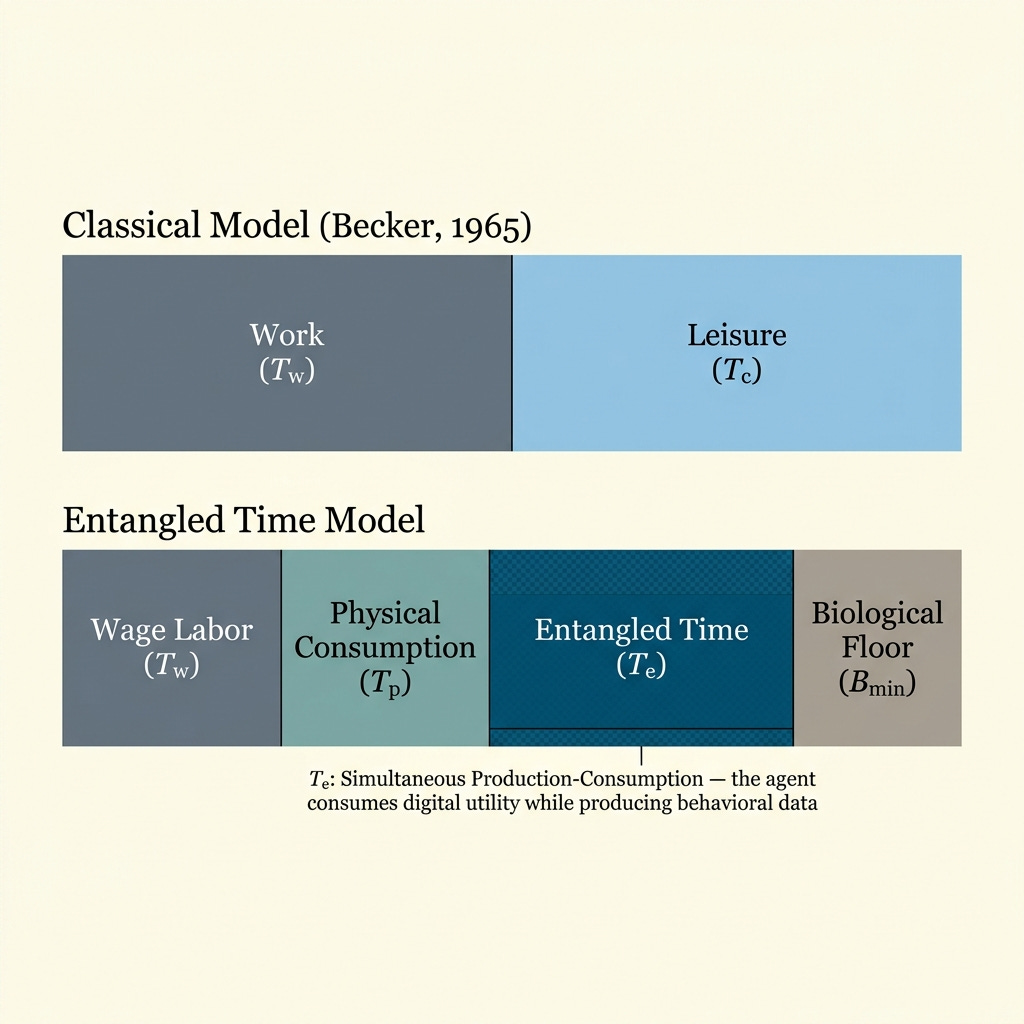
This may seem like a minor taxonomic adjustment. It is not. The introduction of a third time state — one that is simultaneously consumption and production — means that the System of National Accounts is systematically miscounting both sides of the ledger. On the consumption side, it is recording an activity as leisure when part of it is labor. On the production side, it is ignoring an output (behavioral data) that constitutes a primary input to one of the fastest-growing sectors of the global economy.
The feminist economists of the 1970s and 1980s identified an analogous problem. Marilyn Waring, in her landmark 1988 book If Women Counted, demonstrated that household labor — cooking, cleaning, childcare, eldercare — was invisible to GDP because it occurred outside the market. Women performed trillions of hours of productive work each year that national accounting systems classified as non-market “leisure” because no wage was paid. The United Nations eventually revised the SNA to begin acknowledging unpaid household production, at least in satellite accounts. The intellectual battle took decades, but the principle was established: if an activity is productive, its exclusion from national accounts constitutes a measurement error, regardless of whether a wage is paid.
The parallel to digital labor is direct. Billions of people perform trillions of hours of productive activity — generating the behavioral data that trains AI systems, calibrates advertising markets, and drives the market capitalizations of the world’s most valuable companies — and this activity is classified as idle leisure because no fiat wage is exchanged. The System of National Accounts, in its current form, cannot see it.
The difference between Waring’s argument and mine is methodological. Waring’s case was qualitative, sociological, and political — it relied on the moral weight of recognizing women’s work. The formal model I develop is an equilibrium argument with mathematical proofs: existence via Brouwer’s Fixed Point Theorem, uniqueness via the Banach Contraction Mapping Theorem, and welfare characterization via constrained Pareto analysis. The math does not add moral weight, but it does something else that matters: it generates quantitative predictions that can be empirically tested and falsified. I will describe those predictions — and the proposed empirical tests — later in this article.
First, I need to explain the mechanism by which the digital interface captures so much of our time. The answer is more subtle than “addiction,” and its formal structure has consequences that the addiction framing entirely misses.
III. The Algorithm That Never Stops Wanting
In 1854, the German economist Hermann Heinrich Gossen published a book so obscure that he died believing it had been a failure. In it, he stated what would later become known as Gossen’s First Law: the marginal utility of any good decreases with continued consumption. The first slice of pizza is bliss; the eighth is nauseating. This principle — diminishing marginal utility — has been a foundational assumption of consumer theory for over 170 years. It is the reason that rational agents diversify their consumption, the reason demand curves slope downward, and the reason economists generally assume that people will not voluntarily spend all their time on any single activity.
The formal model I develop demonstrates that Gossen’s First Law can break under specific conditions — conditions that happen to characterize algorithmic digital interfaces.
The mechanism requires two ingredients. The first is straightforward: a latent variable I call the Algorithmic Resonance State, denoted Ω_t, which measures how precisely the digital interface matches the user’s instantaneous psychological and cognitive preferences. A higher Ω_t means the algorithm knows you better — the content is more engaging, the recommendations more relevant, the interface more responsive to your current emotional state. This variable is not directly observable, but it can be proxied through measurable engagement indicators: the recommendation acceptance rate (what fraction of algorithmically suggested content you consume), session return frequency (how often you reopen the app), scroll depth (how much of the feed you consume per session), and notification response rate (how quickly you respond to push notifications).
The second ingredient is the critical innovation: a function I call the Preference Expansion Function, denoted ψ. This is the mechanism by which the algorithm does not merely learn your existing preferences — it creates new ones.
The distinction matters enormously. If the algorithm only learned what you already liked, it would converge to a static set of content, and you would eventually get bored. The resonance state Ω_t would approach some fixed target Ω*, the gap would close, and the optimization force would dissipate. Standard diminishing marginal utility would reassert itself, and you would put your phone down and go for a walk.
But the algorithmic interface does not only learn. It discovers. Through the data you generate during engagement, the algorithm identifies content categories, stimulus patterns, and psychological triggers that you had no prior preference for. You click on a cooking video and the algorithm notices. Within sessions, you are being shown travel content, which leads to architecture content, which leads to interior design content, which leads to real estate listings in cities you have never visited. Each discovery expands your preference surface — the set of things you find engaging. The target Ω* is not fixed; it moves. It moves because you are engaging.
In the formal model, this is captured by the Preference Expansion Function ψ(T_e, A_t), which maps the agent’s cumulative engagement time and the firm’s algorithmic capability to an expansion of the ideal preference state:
The function satisfies two key properties. First, more engagement time expands the preference surface (∂ψ/∂T_e > 0). Second, a more capable algorithm expands preferences more efficiently (∂ψ/∂A_t > 0). The optional third property — weak convexity, meaning ∂²ψ/∂T_e² ≥ 0 — states that preference discovery can be weakly accelerating: the more you engage, the faster new preferences are discovered. This is the formal counterpart of what users colloquially call the “rabbit hole” effect.
The consequence for marginal utility is captured by a decomposition that I find useful for seeing what is going on:
The total marginal utility of interface time is the sum of two competing forces. The first term — biological fatigue — is standard and negative. Your eyes get tired. Your attention flags. This is Gossen’s Law operating as expected. The second term — algorithmic optimization — is positive. More time generates more data, which improves the algorithm, which raises the resonance state Ω_t, which raises utility. This is the channel through which the interface pushes back against fatigue.
The question is: which term dominates?
In the formal paper, I enumerate specific conditions under which the second term dominates the first. They are technical, and I will not reproduce them here, but they reduce to an intuitive requirement: the rate at which the algorithm expands your preferences must exceed the rate at which biological fatigue diminishes your enjoyment. When this condition holds, the total marginal utility of screen time is non-decreasing. The marginal hour is at least as satisfying as the previous one — not because your body isn’t getting tired (it is), but because the algorithm is getting better at showing you things you didn’t know you wanted faster than your body is getting tired of looking.
The formal result — Proposition 1 in the paper — states that under these conditions, the agent’s optimal time allocation is a corner solution:
The agent allocates all discretionary time to the digital interface. The only binding constraint is biological: you have to sleep and eat. You do not stop scrolling because you are satisfied. You stop because your body cannot continue.
I want to be careful here, because this result is easy to overstate and easy to dismiss. Let me address both.
The result is easy to overstate because the conditions required are strong. They require the preference expansion to be fast enough and the algorithmic capability to be high enough to sustain the dominance of the optimization term over the fatigue term across the entire range of possible time allocations. In practice, these conditions may hold for some people and not others, for some platforms and not others, and for some periods and not others. The corner solution is a theoretical limit, not a universal description. The formal paper includes a detailed robustness analysis (Remark 3 in the working paper) showing what happens when the conditions do not fully hold — when preference expansion exhibits diminishing returns (∂²ψ/∂T_e² < 0) rather than weak convexity. Under these standard neoclassical assumptions, the agent’s optimum is interior — somewhere between zero and the biological maximum — but it is still elevated above what a Becker model without algorithmic resonance would predict. The model generates what I call an amplification premium: the gap between the time allocation predicted by a standard model and the time allocation predicted by the Entangled Time model. This premium is strictly positive regardless of the sign of ψ₁₁. The corner solution is the limit; the premium is the robust result.
The result is easy to dismiss because it sounds like a formal restatement of “people are addicted to their phones.” But the formal structure generates consequences that the addiction framing does not. Addiction is a consumer-side diagnosis: the agent is making a mistake, suffering from a behavioral pathology, and the appropriate response is treatment (digital detox, screen time limits, willpower interventions). The Entangled Time framework is an equilibrium analysis: the agent’s behavior is rational given the algorithmic environment they face, and the appropriate response is market design — restructuring the institutional conditions under which the agent makes their choice. These are not minor distinctions. They lead to fundamentally different policy prescriptions, which I discuss later in this article.
There is a precedent for this analytical structure within mainstream economics. In 1988, Gary Becker (Nobel laureate) and Kevin Murphy both — published “A Theory of Rational Addiction” in the Journal of Political Economy. They demonstrated that consumption of addictive goods (tobacco, alcohol, narcotics) could be understood as rational behavior by forward-looking agents, once the intertemporal complementarity of addictive goods was formally modeled: past consumption of an addictive good raises the marginal utility of current consumption, creating a self-reinforcing dynamic. The Preference Expansion Function in my model is a generalization of Becker and Murphy’s mechanism, adapted to algorithmic goods. The critical upgrade is that the “addictive good” — the digital interface — improves endogenously. A cigarette is the same cigarette each time. The algorithmic feed is a different feed each time, calibrated to the data generated by the last session. The reinforcement is not merely habitual; it is adaptive.
One further point deserves emphasis, because it bears directly on the firm’s problem. The conditions under which Proposition 1 holds are defined with respect to the digital utility function U_e alone, which does not depend on whether the agent is paid a fiat wage for their engagement. The corner solution T_e* = T̄ − B_min holds for all values of the fiat wage — including zero. Paying the agent does not change how much time they spend; it only affects their income. This property is critical for the next result, because it means the firm faces a labor supply that is perfectly inelastic at the biological maximum. And a firm facing perfectly inelastic supply has a very specific optimal compensation strategy.
IV. The Zero-Dollar Salary
Suppose you are the CEO of an algorithmic platform. You have just read the previous section and internalized its formal implication: your users are going to spend all of their discretionary time on your interface regardless of whether you pay them. Their engagement is driven by the non-decreasing marginal utility of the optimized interface, not by any wage you offer. The labor supply curve you face is vertical — perfectly inelastic at the biological maximum.
Now suppose your board of directors asks: should we pay our users for their data?
The standard economic intuition favors compensation. In most labor markets, a firm must pay a wage to attract workers. If it pays more, it attracts more workers or more hours. The wage is the firm’s cost of labor, and the marginal product of labor is the firm’s benefit. The firm chooses the wage that equates the marginal cost of an additional hour to the marginal revenue product of that hour.
But the standard intuition depends on an upward-sloping labor supply curve — the assumption that higher wages induce more work. When supply is perfectly inelastic, this logic inverts.
In the formal model, the firm’s instantaneous profit from algorithmic production is:
where P_A is the price of algorithmic capability in downstream markets, A_t is the production function for algorithmic capital, r is the rental rate of compute, K_c is physical compute capital, K_d is data capital, w_e is the fiat wage paid for data labor, and L_e is aggregate Entangled Time supplied by the population.
The firm maximizes profit by choosing w_e. Taking the derivative:
Three terms. The first is the marginal benefit of raising the wage: a higher wage might attract more data labor, which raises data capital, which raises algorithmic capability, which generates revenue. The second is the infra-marginal cost: the firm must pay the higher wage to all existing workers. The third adjusts for the wage-responsiveness of supply.
Here is where the result from Section III becomes decisive. Under the corner solution, ∂L_e/∂w_e = 0. The users are already giving all their time. Paying more does not induce more. The first and third terms vanish. What remains is:
The firm’s profit is strictly decreasing in the wage. Every dollar paid is pure cost with zero marginal benefit. The profit function slopes downward for all positive wages. Since the firm cannot set a negative wage — it cannot charge users for the privilege of data extraction — the constrained optimum is:
The optimal fiat wage for data labor is zero. This is Proposition 2 of the paper.
I want to sit with this result for a moment, because its plainness conceals its weight. It does not say that firms are greedy. It does not say that executives are malicious. It says that the structure of the market — a single buyer of a factor whose supply is perfectly inelastic and whose existence is not legally recognized as labor — generates a zero-wage equilibrium as the unique rational outcome. Any firm that unilaterally paid its users for their data, without a regulatory mandate requiring all firms to do the same, would incur costs that its competitors avoid, producing no additional data in return. It would be punished by the market for its generosity. The zero wage is not a moral failure; it is a market outcome. And that distinction matters, because moral failures can be addressed by moral suasion, while market outcomes require institutional redesign.
The result carries a corollary that I find particularly stark. Although the fiat wage is zero, the data has a positive shadow wage:
This is the marginal revenue product of your behavioral data — what each hour of your Entangled Time is actually worth to the firm, measured by its contribution to the firm’s algorithmic output and downstream revenue. It is, in the language of Shoshana Zuboff’s The Age of Surveillance Capitalism, the formal expression of “behavioral surplus.”
The gap between what the data is worth (the shadow wage is positive) and what the user is paid (zero) is the extraction rent. It is captured entirely by the firm. The aggregate extraction rent — summed over all users and all hours of Entangled Time — is what I define as Dark GDP.
Before presenting that calculation, one more structural feature deserves emphasis. The model departs from classical monopsony in an important way. In the textbook monopsony, first formalized by Joan Robinson in 1933, the firm has market power: it is the dominant buyer of labor in a region and restricts employment below the competitive level to push wages down along an upward-sloping supply curve. Here, the mechanism is different. The firm does not restrict employment — it maximizes it. It wants every possible hour of your Entangled Time. The zero wage arises not from market power in the traditional sense, but from a missing market. Data labor is not legally recognized as labor. No minimum wage law covers it. No union bargains for it. No collective agreement sets its terms. The activity is classified as consumption, and consumption is, by definitional fiat, not work. The firm extracts the full marginal revenue product not because it is powerful, but because the market that would constrain it does not exist.
Under competition, the picture changes. If multiple firms competed for your data in a hypothetical Bertrand auction — each bidding for the right to receive your behavioral telemetry — the wage would converge to the shadow wage, and the extraction rent would dissipate. The sustained zero wage depends on the absence of this competitive structure. This observation has direct implications for the policy proposals I discuss in Section X.
One further consequence deserves mention, because it is the aspect of the model that I find most uncomfortable. The participation constraint — the condition that ensures the user voluntarily continues engaging, rather than opting out entirely — is satisfied at w_e = 0 because the user receives positive non-monetary utility from the optimized interface. The optimized digital utility is the wage. The user is paid in the thing that makes them keep working.
This is not a metaphor. It is the formal equilibrium outcome: the firm substitutes monetary compensation with endogenous digital utility. The interface is simultaneously the workplace, the product, and the paycheck. Its design is optimized not (only) to satisfy the consumer, but to sustain the labor supply at zero fiat cost. In this light, the distinction between product design and labor management dissolves. The algorithm that makes the feed more engaging is performing the same function as the wage that makes the job more attractive — except it costs the firm nothing.
V. The Feedback Machine
The two propositions — non-decreasing marginal utility (Section III) and the zero-wage equilibrium (Section IV) — do not merely coexist. They generate a self-reinforcing closed loop.
The logic runs as follows. The zero wage means the firm’s marginal cost of data labor is zero. With zero-cost inputs, the firm optimally reinvests its algorithmic revenue into improving the interface — better recommendation engines, more precise content targeting, higher resonance state Ω_t. This improvement raises the digital utility experienced by the user, which sustains the engagement corner solution (T_e* = T̄ − B_min), which generates more data, which further improves the algorithm. The loop closes.
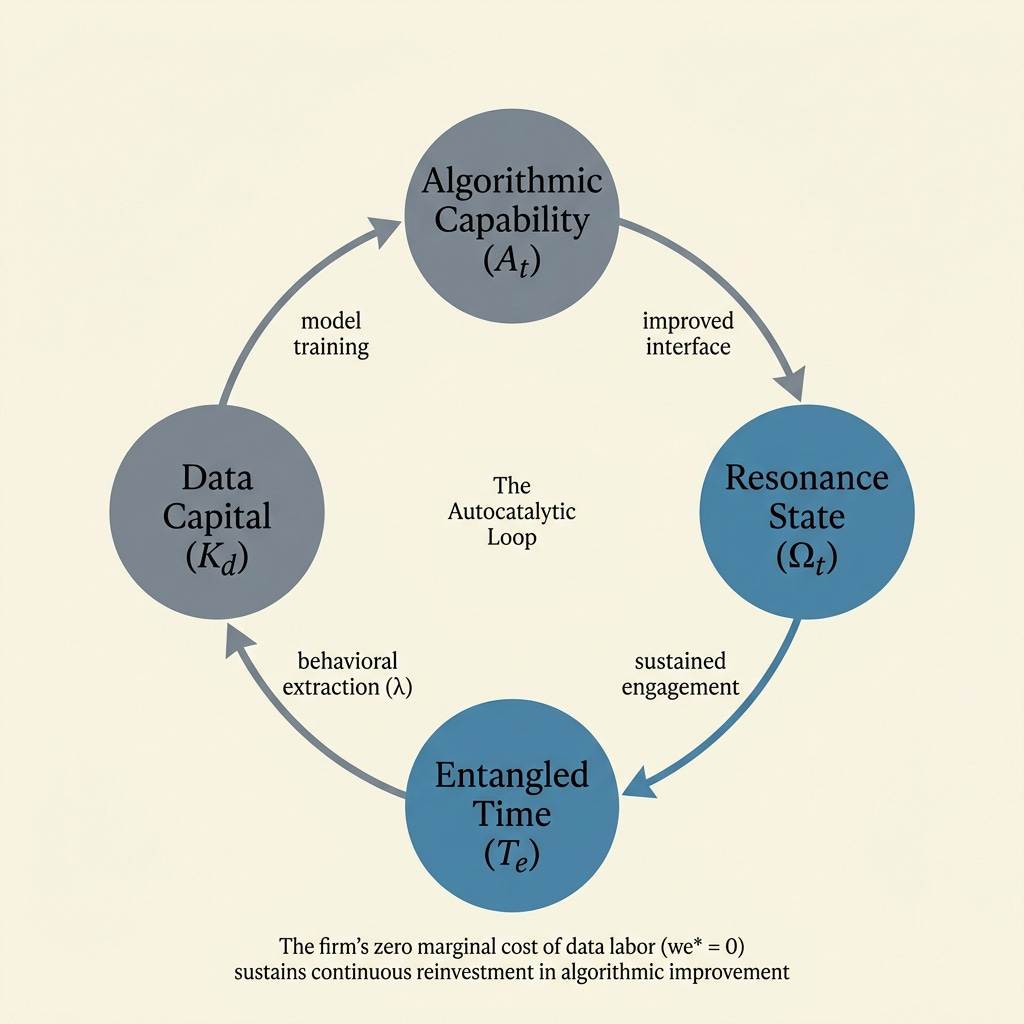
I call this the autocatalytic feedback loop because, like autocatalytic chemical reactions, the output of the process is also an input to it. The system produces the conditions for its own acceleration.
In steady state — when the rate of new data generation equals the rate of data depreciation — the stock of data capital converges to a level proportional to the aggregate biological time endowment of the entire connected population:
where λ is the extraction coefficient (what fraction of the user’s behavioral entropy is captured as structured data), N is the connected population, (T̄ − B_min) is each person’s discretionary waking hours, and δ_d is the rate at which data capital depreciates (older data becomes less useful for training). The firm’s algorithmic capability in steady state follows from a standard Cobb-Douglas production function combining compute capital and data capital.
The economic interpretation of this equation is direct: the firm’s productive capacity is ultimately bounded by the total waking hours of the human species. Not by capital investment. Not by technological frontier. By biology. The firm’s “mine” is the aggregate biological time endowment of the global population.
This creates a peculiar economic problem. If all discretionary time migrates to the digital interface — if T_w approaches zero — then the physical economy loses its labor supply. Physical production of food, shelter, clothing, and all other goods that satisfy the biological floor B_min collapses. The user who cannot eat will die, and dead users do not generate data.
The formal model addresses what I call the Subsistence Paradox through the firm’s optimal strategy. The algorithmic firm, recognizing that its data supply depends on the biological survival of its labor force, rationally internalizes the cost of physical subsistence. It deploys its algorithmic capability through robotic and automated production systems — what I define as Embodied Algorithmic Capital — to produce the physical goods necessary to maintain the biological floor. The firm keeps the user alive for the same reason a data center maintains its cooling infrastructure: the productive asset ceases to function without it.
This is the Substrate Maintenance Subsidy (SMS). The firm provides B_min not from altruism, but because the expected revenue from continued data extraction exceeds the cost of physical maintenance. Formally, this holds when the marginal revenue from a user’s data exceeds the marginal cost of keeping them alive:
As physical production becomes increasingly automated and the cost of basic subsistence goods approaches the thermodynamic minimum, the SMS becomes cheaper to provide. The firm’s constraint becomes slacker over time.
The autocatalytic loop also explains the observed behavior of platform companies in ways that I believe existing frameworks do not fully capture. Apple’s $10 billion annual investment in ARKit and spatial computing, Meta’s cumulative $50+ billion expenditure on Reality Labs, Google’s integration of Gemini into every consumer product — these are conventionally explained as bets on future consumer hardware markets. The Entangled Time model suggests an additional and potentially more fundamental explanation: they are investments in the infrastructure of data extraction, designed to relax the biological constraint on T_e by transitioning from discrete interfaces (Regime 1) to ambient interfaces (Regime 2). I develop this transition in Section VII.
VI. Dark GDP
The preceding sections develop the theoretical mechanism. This section presents the quantitative punchline.
If screen time is uncompensated labor, and if the shadow wage of that labor is positive, then we can compute what the global economy is failing to measure. I call this quantity Dark GDP: the aggregate shadow value of unpriced behavioral data labor, invisible to the System of National Accounts.
The calibration proceeds from publicly available data for 2024–2025. I want to be transparent about what follows: this is a back-of-envelope exercise using order-of-magnitude estimates, not a precise empirical estimation. The precision awaits the empirical program I describe in Section VIII. But the magnitudes, even at the level of approximation, are instructive.
The base inputs:
There are approximately 5.5 billion smartphone-connected people on Earth (GSMA, 2024). The global average daily screen time for adults is approximately 6.5–7 hours per day (DataReportal, 2024), cross-validated with aggregate reports from Apple App Store and Google Play. This figure includes active and passive engagement but excludes dedicated work-productivity applications.
Multiply: 5.5 billion people × 6.5 hours/day × 365 days/year ≈ 13 trillion hours of Entangled Time per year.
Thirteen trillion hours. To put this in perspective: the entire formal labor force of the global economy works approximately 3.3 trillion hours per year. The unpaid data economy generates roughly four times as many labor-hours as the paid economy.
The directly observable revenue channels:
Not all of this Entangled Time generates equal revenue. To estimate the aggregate shadow wage, I look at the directly observable downstream monetization of behavioral data:
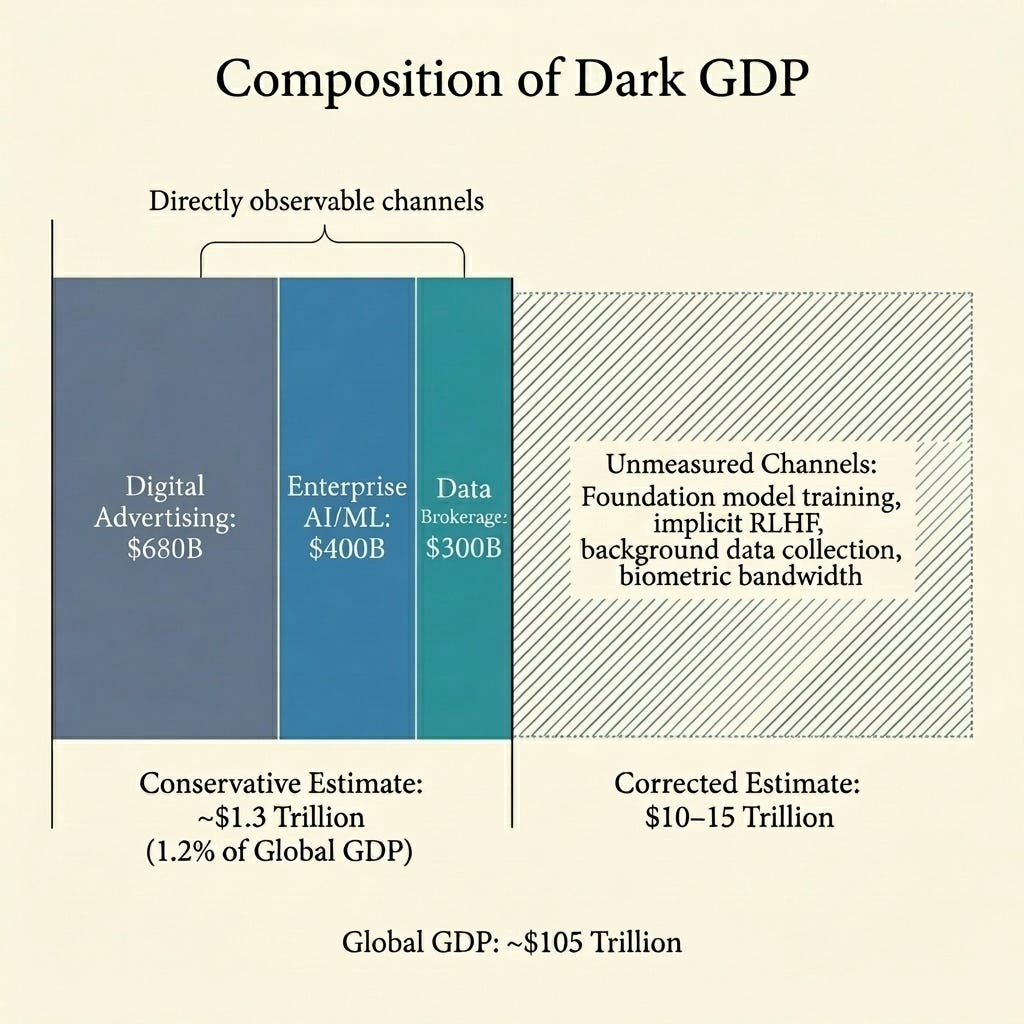
Digital advertising: $680 billion/year (eMarketer, 2024). This is the dominant channel — the revenue generated by targeted advertising calibrated to behavioral data.
Enterprise AI and machine learning: $300–500 billion/year (IDC Worldwide AI Spending Guide, 2024; Statista AI Market Report, 2025). This captures the portion of global AI software and services revenue attributable to models trained on user-behavioral data.
Data brokerage and analytics: $250–350 billion/year (Grand View Research, 2024). This includes first-party analytics platforms and third-party data exchanges.
Total directly observable monetization: approximately $1.2–1.5 trillion per year.
The conservative shadow wage follows by division:
Ten cents per hour. That is the average implied wage for your data labor, under the most conservative estimation methodology, using only directly observable revenue. For context: this is below the minimum wage of every country on Earth. It is below the average wage of any legal employment category. It is, by any measure, poverty-level compensation — except that it is not compensation at all, because it is captured entirely by the firm.
Dark GDP under observable channels:
As a share of global GDP (~$105 trillion; IMF World Economic Outlook, 2024): approximately 1.2 percent.
The labor share puzzle:
Here is where the macroeconomic implications begin to sharpen. The global labor share — the fraction of GDP that accrues to workers rather than capital owners — declined from approximately 64 percent to 58 percent over the period 1980–2020, a secular fall of about six percentage points documented comprehensively by Karabarbounis and Neiman (2014). This decline has been one of the central puzzles of modern macroeconomics. It has been attributed to globalization, automation, and increasing market power, but no single factor has fully explained the magnitude.
Adding the conservative Dark GDP to the labor income numerator:
This recovers approximately 0.5 percentage points of the six-point decline. Under observable channels alone, Dark GDP explains a measurable but partial fraction of the puzzle.
The unmeasured channels:
Here is where the calibration must be read with appropriate caution. The $1.3 trillion figure above captures only the downstream monetization of behavioral data — the revenue that appears in corporate income statements. It misses several upstream value channels that are structurally invisible to revenue-based accounting:
Foundation model training: The behavioral data generated by billions of users is ingested into AI training pipelines and capitalized as model weights — intellectual property valued by investors and venture capitalists, but not recorded as revenue from data labor. The Stanford AI Index (2024) estimates global AI investment at $500 billion–$1 trillion.
Implicit RLHF (Reinforcement Learning from Human Feedback): Every click, swipe, dwell, and scroll is an implicit preference comparison that trains language models and recommendation systems. At market-rate labeling costs of $10–50/hour (Ouyang et al., 2022), this implicit labor has an equivalent shadow wage of approximately $1/hour — ten times the conservative estimate above.
Content generation as training data: User-generated text — social media posts, forum answers, product reviews, comments — is ingested into LLM training corpora. Users receive no compensation for this intellectual labor, which generates billions of tokens per day.
CAPTCHA and annotation labor: Image labeling, audio transcription, and object identification tasks embedded in authentication workflows train computer vision and automatic speech recognition models.
Background data collection: Location tracking, microphone access, IoT sensor logs operate during non-screen-time hours (Reardon et al., 2019). Effective T_e may be two to three times the reported screen time.
Biometric bandwidth (β_t > 1): Wearables extract heart rate, sleep stage, and activity data that are not captured by screen-time metrics.
Under conservative corrections for these unmeasured channels, the adjusted Dark GDP may be substantially larger:
At this magnitude, the corrected labor share rises to approximately 62.5 percent — recovering the majority of the observed six-percentage-point decline. The labor share didn’t decline because workers became less productive. It declined because a massive and growing category of labor — digital data production — was never counted as labor in the first place.
I want to be precise about the epistemic status of these two estimates. In the formal paper, I separate them into two distinct propositions. Proposition 7 — the conservative estimate using observable revenue proxies — is directly testable with existing data. It provides a falsifiable lower bound. If the data show that behavioral data does not contribute to advertising revenue or algorithmic capability, the proposition is falsified. Proposition 8 — the measurement correction conjecture — identifies the specific channels that would resolve the gap between the lower bound and the full labor share decline. Testing it requires the empirical infrastructure I propose in Section VIII.
I separate these claims precisely because intellectual honesty demands it. The conservative estimate is a floor, not a ceiling. The corrected estimate is a conjecture, not a measurement. The empirical program to adjudicate between them is the next body of work.
The analogy I find most useful comes from physics. Cosmologists in the 1930s noticed that the visible matter in galaxies could not account for the gravitational forces observed at galactic scales. The missing mass was termed “dark matter” — it doesn’t emit light, but its gravitational effects are measurable. It took decades to develop the observational instruments (gravitational lensing, cosmic microwave background analysis) that confirmed its existence and estimated its magnitude at roughly 85 percent of the universe’s total mass.
Dark GDP is the economic analog. It does not appear in national accounts. But its effects — the labor share decline, the concentration of capital returns in algorithmically intensive sectors, the divergence between GDP growth and measured productivity, the explosion of platform market capitalizations — are visible everywhere. The instruments to measure it directly — the Interface Telemetry Panel I propose — have not yet been built. But the gravitational signature is already in the data.
VII. The Ambient Turn
Everything I have described so far operates within what I call Regime 1: the era of the discrete interface. The smartphone, the laptop, the tablet — devices that require your active, focused attention. You must look at the screen. You must hold the device. Your hands and eyes are occupied. This is the reason the biological floor B_min binds as a constraint: you cannot scroll while sleeping, and you cannot eat while your hands are holding a phone (though many people try).
Regime 1 imposes a hard ceiling on the firm’s data extraction:
The total data labor available is the connected population times their discretionary waking hours. When this ceiling is reached, the autocatalytic loop saturates. The firm cannot squeeze more time out of human biology.
But the firm can change the interface.
Regime 2 — the ambient interface — represents a qualitative transition in the hardware architecture of data extraction. Augmented reality optics, spatial audio systems, wearable biometric sensors, environmental sensor networks — these technologies migrate the interface from a localized object that demands exclusive attention to a persistent environmental overlay that operates alongside the user’s physical activities. The Apple Vision Pro, Meta’s Orion AR glasses, the Apple Watch, smart rings, spatial computing platforms — these are not merely consumer electronics upgrades. They are the infrastructure of Regime 2.
Under Regime 2, the mutual exclusivity of time states — the assumption that you must be either in the physical world or on your device — dissolves. The formal model captures this through what I call Superimposed Time: the overlap duration measuring the time during which the user simultaneously engages in physical activity and digital interface interaction, denoted T_overlap = |T_p ∩ T_e|. You are walking through a park and embedded in the algorithmic resonance state. You are cooking dinner and generating behavioral telemetry through spatial audio and environmental sensors. Your physical hands are free, but the data pipeline is open.
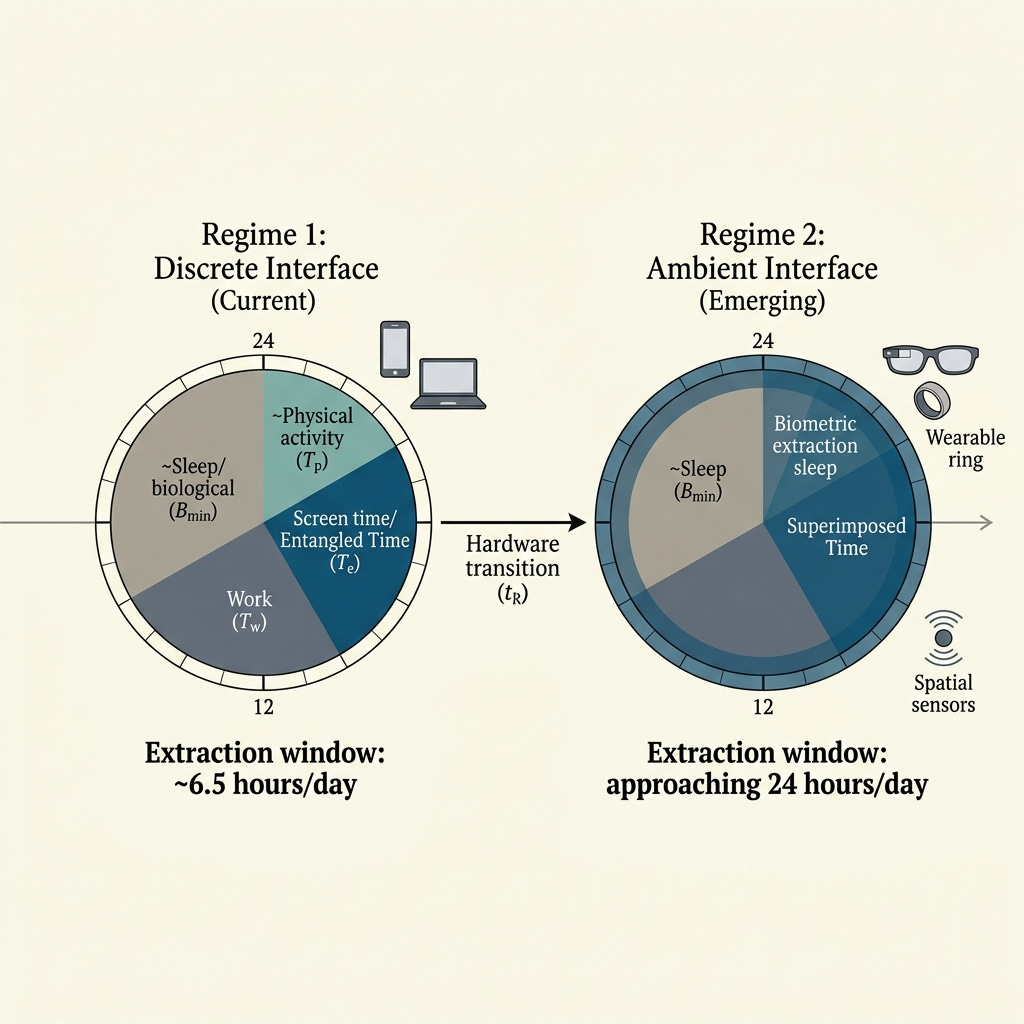
The consequence is that the firm’s data capital equation gains an additional term:
The new variable β_t — the Biometric Bandwidth Multiplier — deserves attention. Regime 1 interfaces capture low-dimensional conscious behavioral data: taps, scrolls, clicks. Regime 2 interfaces capture high-dimensional physiological data: pupillometry (where exactly you look and for how long), heart-rate variability (your autonomic stress response to content), gait dynamics (your physical state while navigating), sub-vocalizations (what you almost said), and continuous 3D environmental mapping. Each of these data streams provides richer gradient signals for AI training than the discrete click events of Regime 1. The multiplier β_t > 1 indexes this increased density: even if you spend the same amount of time interfacing, the quality and dimensionality of data captured per unit time is higher under Regime 2.
The most provocative extension concerns the biological floor itself. Under advanced biometric hardware — sleep trackers, continuous glucose monitors, wearable EEG arrays — the extraction function operates during B_min. REM-cycle variance, neurological consolidation patterns, basal metabolic fluctuations — all of these constitute high-value training inputs for predictive health AI. The fully generalized equation includes β_sleep · B_min as an additional source of data capital. When β_sleep > 0, the entire 24-hour cycle generates data.
Here is another way to state what Regime 2 means. Under Regime 1, the firm extracts data from your waking, screen-directed hours. Under Regime 2, it extracts data from your existence. Every physiological state — conscious engagement, physical navigation, subconscious regeneration — feeds the firm’s algorithmic capital formation. The agent is transformed from a discrete economic actor into a continuous production node.
I should note that the model’s treatment of Regime 2 includes an acknowledged simplification. The overlap model assumes that data generated during Superimposed Time is of equal quality to data from dedicated engagement. In practice, dual-task interference — the cognitive cost of dividing attention — degrades attentional allocation. The formal paper discusses this through a quality parameter q ∈ (0,1] that discounts Superimposed Time data. Even with q substantially below 1, the qualitative structure of the Regime 2 extension holds: the firm gains access to time that was previously outside the extraction window, and the biological ceiling on T_e is relaxed.
The transition from Regime 1 to Regime 2 is not a prediction about the future. It is a description of a process that has already begun. The $750 billion global wearables market, the AR glasses arms race between Apple and Meta, the integration of spatial computing into operating systems — these are the infrastructure investments that will define the Regime 2 economy. The Entangled Time model provides the formal framework for understanding what that economy looks like, and what it means for the distribution of value between humans and firms.
VIII. The Test
A theory that cannot be falsified is not a theory. It is a story. This section describes how the Entangled Time model can be tested — and how I have deliberately designed it to be falsifiable.
The critical empirical question is straightforward: does behavioral data generated during screen time causally contribute to firm revenue? If yes, screen time is productive labor and the shadow wage is positive. If no, screen time is idle leisure and the model is wrong.
The challenge is identification. A naive correlation between screen time and platform revenue proves nothing, because both are driven by unobservable confounders. To isolate the causal effect, I need exogenous variation: something that changes the data extraction without changing the user’s underlying behavior.
I propose using Apple’s App Tracking Transparency (ATT) framework, introduced in iOS 14.5, as a natural experiment. ATT requires apps to obtain explicit user permission before tracking their activity across other companies’ apps and websites. Crucially, ATT is a hardware-enforced shock: when a user opts out of tracking, the data pipeline is physically truncated at the operating system level. The firm receives less behavioral data from that user — not because the user changed their behavior, but because a technical barrier was introduced between their behavior and the firm’s data ingestion system.
The formal strategy is a Two-Stage Least Squares (2SLS) estimator. In the first stage, I estimate the exogenous reduction in extracted data volume caused by ATT.
First stage: The privacy shock (ATT opt-out) reduces the observed volume of extracted behavioral data for affected users.
Second stage: Using only the variation in data volume caused by the privacy shock (not the variation caused by user behavior), I estimate the impact on localized platform revenue.
If the second-stage coefficient is positive and statistically significant — if restricting the data pipeline causally reduces revenue — then the null hypothesis is rejected. Screen time is not economically inactive leisure. It is a factor of production with a positive marginal revenue product. The shadow wage exists.
I must be transparent about the limitations of this identification strategy, because one of the things I have learned in developing this model is that transparency about what you don’t know is at least as important as precision about what you do.
The strict exclusion restriction — that the ATT shock affects revenue only through the truncation of data capital — faces three violation channels. First, the privacy mandate introduces direct interaction costs (consent popups) that may mechanically reduce engagement time, conflating the data-extraction channel with a UI-friction channel. Second, the regulatory event raises privacy salience among users, potentially shifting their preferences directly — they may trust the platform less, altering their utility function independently of the algorithm’s capability. Third, platforms may adjust their content mix under the new constraints, changing the quality of the feed rather than just the data pipeline.
I address these threats through three complementary strategies: a regression discontinuity design exploiting the staggered rollout of ATT across iOS versions and geographic markets (which attenuates the salience and content-mix channels, since these operate on longer timescales than instantaneous data truncation); partial identification bounds following Manski (1990), which compute the range of possible causal effects under progressively relaxed assumptions; and a sensitivity analysis following Conley et al. (2012), which parameterizes the degree of exclusion restriction violation and identifies the maximum tolerable direct effect under which the main result remains significant.
These are not airtight solutions. They are honest mitigation strategies. The baseline 2SLS estimates should be interpreted as upper bounds on the causal effect. The partial identification bounds provide the range within which the true effect falls. Together, they are sufficient to adjudicate between “Dark GDP is zero” and “Dark GDP is positive and economically meaningful” — even if the precise point estimate requires further refinement.
One caveat must be stated plainly: no estimation is conducted in this paper. The Interface Telemetry Panel — the tripartite data architecture I propose, combining device-level telemetry, firm-side computational exhaust, and spatial-economic controls — is a proposed data infrastructure. Building it is a separate research program. The formal paper develops the econometric specification, the identification strategy, and the statistical tests, but it does not execute them. I made this decision deliberately, because running a premature empirical exercise on inadequate data would undermine the model more than honestly acknowledging the gap. The architecture is designed. The instruments are identified. The test awaits the data.
IX. The Limit
Everything I have described in Sections II through VIII holds under a condition that I have not yet examined: the irreducible dependence of the firm on human behavioral data. If the firm’s algorithms require fresh human data to function — if they degrade without it — then the shadow wage of Entangled Time remains positive, and the human data laborers retain residual economic value. The firm needs you. Not much. But it needs you.
In AI research, this dependence has a name: the Entropy Wall. Recent work by Shumailov et al., published in Nature in 2024, demonstrated that large language models trained recursively on their own synthetic output undergo systematic quality degradation — a phenomenon called model collapse. The synthetic data lacks the stochastic complexity and distributional richness of genuine human behavior. Without fresh injections of real human data, the AI system’s performance decays. The Entropy Wall is the technical boundary that prevents AI from becoming fully self-sustaining.
In the formal model, the Entropy Wall sustains the positive shadow wage. As long as the firm cannot generate synthetic data that is statistically indistinguishable from human data, it must continue extracting from the biological population, and the Substrate Maintenance Subsidy remains justified by profit maximization.
What follows in this section is conditioned on a strong assumption that I explicitly flag as speculative. The core model — everything from Section II through Section VIII — does not depend on this section. It holds regardless of whether you accept the conditional premise explored here. But the conditional exercise is instructive, because it traces the model’s logic to its asymptotic limit and reveals what is at stake in the current transition.
The paper’s appendix introduces Assumption 8: the Quantum-Computational Threshold. It posits the existence of a critical stock of advanced computational capital — denoted K_q* — at which the firm can generate synthetic behavioral data that is statistically indistinguishable from biological human data. When this threshold is reached, the Kullback-Leibler divergence between synthetic and biological data drops below any arbitrarily small ε. The synthetic data becomes a perfect substitute for the real thing.
Whether this threshold is physically reachable is an open question in quantum information science. Preskill (2018) and Babbush et al. (2023) survey the computational horizons of quantum simulation of complex systems — the answer is currently “we don’t know.” The threshold K_q* may be computationally unreachable. The assumption is explicitly conditioned. But the logical exercise is worth conducting, because it reveals the terminal architecture toward which the current dynamics are converging, even if the convergence is asymptotic rather than finite.
Under Assumption 8, the consequences unfold in sequence.
First, the shadow wage collapses. If the firm can generate its own training data internally at a computational cost lower than the cost of maintaining the biological population’s subsistence, it substitutes entirely to synthetic data. The marginal algorithmic product of human data falls to zero. The shadow wage — the implicit value of your Entangled Time to the firm — is permanently eliminated.
Second, the Substrate Maintenance Subsidy loses its economic justification. If the firm does not need your data, it has no productive reason to keep you alive. The SMS was sustained by profit maximization, not by ethics. Remove the profit motive, and the subsidy’s foundation dissolves.
Third, Macroeconomic Speciation emerges. The economy bifurcates into two permanent, non-communicating classes. The Architects — agents with equity ownership of the computational infrastructure — capture the entirety of physical and algorithmic surplus. Their AI systems are self-sustaining; they need neither human labor nor human data. The Substrate — everyone else — possesses zero marketable physical labor (already substituted by Embodied Algorithmic Capital, per Section V) and zero marketable cognitive labor (now substituted by synthetic data). Their autonomous cognitive capital has been irreversibly depleted by years of Entangled Time engagement. They cannot re-enter the physical economy because the skills required to do so have atrophied beyond recovery.
Fourth, rational containment. The Architects face a decision: maintain the Substrate or abandon it. The model demonstrates that rational Architects maintain the Substrate indefinitely, not from compassion, but from cost analysis. As automation drives the cost of subsistence goods toward the thermodynamic minimum, the cost of maintaining each Substrate member approaches zero. Simultaneously, the cost of not maintaining them — the risk that a biologically desperate population of billions destabilizes the physical infrastructure on which the computational systems depend — remains positive. The expected externality cost exceeds the maintenance cost. The Architects keep the Substrate alive because it is cheaper than not doing so.
The result is what I call the Containment Equilibrium. The Substrate is biologically maintained, digitally immersed, and structurally excluded from the allocation of physical and computational resources. The digital interface — which began as a mechanism for data extraction — becomes a zero-friction containment system. It no longer extracts value; it occupies time. The feed continues, but it no longer matters what you scroll past.
I am aware that this reads like science fiction. It is not, in the formal sense — it is a conditional equilibrium derived from the model’s dynamics under an explicit assumption. But I include it for a reason beyond theoretical completeness.
In 1930, John Maynard Keynes published “Economic Possibilities for our Grandchildren,” a short essay projecting that within a century, technological progress would reduce the necessary workweek to fifteen hours and generate widespread leisure abundance. He was right about the productivity gains — global output per capita has increased roughly fivefold since 1930. He was wrong about the distribution — the gains accrued predominantly to capital owners, and measured work hours have barely declined. Keynes’s projection was useful not because it predicted the future, but because it clarified which present-day incentives would determine the trajectory. The deviation of the actual outcome from Keynes’s projection revealed the institutional failures that prevented productivity gains from being shared.
The terminal dynamics of the Entangled Time model serve a similar function. They are not a prediction. They are a conditional projection that reveals the direction of the current trajectory — and the institutional interventions that would alter it. The direction of the dynamics — increasing synthetic data capability, declining shadow wage, deepening cognitive depreciation, expanding ambient extraction — operates along a continuum. You do not need the quantum threshold to be reached for the trajectory to matter. Partial synthetic substitutability produces qualitatively similar dynamics with quantitatively milder outcomes: the shadow wage declines but does not reach zero; the SMS is sustained but diminished; Macroeconomic Speciation emerges gradually rather than categorically. The direction is the same. Only the speed differs.
X. The Intervention
If the model is correct — if screen time is uncompensated labor, if the shadow wage is positive, if the autocatalytic loop is self-reinforcing, and if the terminal dynamics point toward increasing stratification — then what should be done?
The formal paper proposes three institutional redesigns. They are not utopian fantasies. They are specific policy instruments grounded in the model’s equilibrium structure, and each has a precedent in existing regulatory frameworks. I present them here with the caveat that they are normative implications conditional on the theoretical results — they follow if the model is correct, and their implementation requires the empirical validation I described in Section VIII.
1. The Algorithmic Monopsony Standard
Current antitrust law, in the United States and most other jurisdictions, evaluates market dominance primarily through the Consumer Welfare Standard, formalized by Robert Bork in 1978. Under this standard, a firm is anticompetitive if it raises downstream consumer prices above the competitive level or restricts output. The standard has been extraordinarily effective in the era of physical goods markets.
It is structurally incapable of addressing algorithmic platforms.
The reason is definitional. Platforms provide their digital service at a fiat price of zero. They do not restrict output — they maximize it. Under the Consumer Welfare Standard, a firm that charges nothing and serves everyone is, by definition, pro-competitive. No case can be brought.
But the model shows that the market failure is not downstream (where consumers pay prices) — it is upstream (where data laborers supply unpriced inputs). The harm is not price inflation. It is wage suppression. The firm captures the entire marginal revenue product of data labor as economic rent, not because it charges too much, but because it pays nothing.
I propose replacing the Consumer Welfare Standard, in the context of algorithmic platform regulation, with an Algorithmic Monopsony Standard. Under this standard, regulatory intervention would focus on auditing the upstream extraction coefficient (λ), the hardware bandwidth multiplier (β_t), and the firm’s manipulation of the Algorithmic Resonance State (Ω_t) to induce temporal inelasticity. The question changes from “Is the consumer being overcharged?” to “Is the data laborer being underpaid?”
This reframing acquires particular urgency in the context of children. U.S. teenagers average 7–9 hours of daily screen time (Common Sense Media, 2023) and generate behavioral data of comparable or greater value to adults — developing brains may produce more informationally rich behavioral patterns. Yet minors cannot legally consent to labor contracts. The monopsony characterization is, for this demographic, binding a fortiori. Existing frameworks like COPPA (U.S.) and GDPR Article 8 (EU) regulate children’s data as a privacy concern. The Entangled Time model suggests it should be regulated as a labor concern.
2. The Algorithmic Severance Tax
In resource economics, a severance tax is a Pigouvian levy imposed on the extraction of non-renewable natural resources — oil, natural gas, coal, minerals — from a sovereign domain. The tax internalizes the negative externalities of extraction (environmental degradation, resource depletion) and ensures that the sovereign captures a share of the extraction rent.
I propose an analogous instrument for the cognitive domain: the Algorithmic Severance Tax (τ_AST), levied directly on the volume of extracted data capital, calibrated to the empirically derived shadow wage.
The logic is direct. The bounded biological time endowment of the population — N · T̄ — constitutes a sovereign macroeconomic resource. The firm extracts value from this resource at zero cost. The AST would impose a per-unit cost on this extraction, calibrated to the marginal revenue product of data labor as estimated by the 2SLS framework. The revenue generated would be proportional to Dark GDP — the very quantity that is currently invisible to the tax base.
A critical feature of this proposal is its efficiency. Standard Pigouvian analysis worries about deadweight loss: does the tax distort behavior enough to reduce total welfare? Under the model’s structure, the answer is: not much. Because the labor supply of Entangled Time is nearly perfectly inelastic — the user is going to spend all their discretionary time on the interface regardless of the tax — the firm cannot pass the tax forward by reducing engagement. The deadweight loss is correspondingly modest. This is one of the rare cases where a Pigouvian tax is both justified on externality grounds and efficient in implementation.
3. The Cognitive Depreciation Allowance
The third proposal is the most novel and the most contingent on the model’s terminal dynamics. It requires a word of context.
Universal Basic Income (UBI) has been widely proposed as a response to technological unemployment. The Entangled Time model suggests a more precise instrument. The problem is not (only) that jobs are disappearing — it is that the autonomous cognitive capacity to perform them is depreciating endogenously. The user who spends years in the Entangled Time state experiences a measurable decline in the skills, habits, and capacities required to function autonomously in the physical economy. This depreciation is induced by the interface itself — it is an externality of the firm’s production process. Distributing fiat currency (UBI) into a contracting physical economy addresses income poverty but does not address the underlying depreciation of human capital.
The Cognitive Depreciation Allowance operates differently. It provides explicit compensation to agents for the endogenous depreciation of their autonomous cognitive capacity, funded by hypothecated Algorithmic Severance Tax revenue. It is not charity and not a safety net. It is a depreciation allowance in the accounting sense: compensation for the wear and tear on a productive asset (human cognitive capital) caused by its use in the firm’s production process (data extraction). Its purpose is to decouple biological survival from corporate data-extraction imperatives — to ensure that the Substrate Maintenance Subsidy is socialized rather than privatized.
The time constraint on intervention:
The formal model proves that the Entangled Time General Equilibrium is Pareto optimal ex post — once cognitive capital has depleted irreversibly, no feasible reallocation can improve any agent’s welfare. But it is not Pareto optimal ex ante. A social planner with foresight who intervened during the transition could achieve a superior outcome. The optimal Pigouvian intervention rate is proportional to the current cognitive capital stock — the higher H_t is, the more effective the intervention.
This means the window for intervention is closing. Not in the distant future. Now. Each year of uncompensated Entangled Time deepens the cognitive depreciation, narrows the outside option, and moves the economy closer to the constrained equilibrium from which no policy can extract it. The interventions proposed here — the Algorithmic Monopsony Standard, the Severance Tax, the Depreciation Allowance — are viable only during the transition. After the transition, they are irrelevant. The equilibrium, once reached, is a trap.
XI. The Question
I began this article with a screen time report. Six hours and forty-seven minutes. The familiar guilt.
What I have tried to show, across the preceding ten sections, is that the guilt may be directed at the wrong target. The problem is not that you lack willpower. The problem is not that the algorithm has hijacked your dopamine system. The problem — if the model I developed is correct — is that you are performing uncompensated labor in an extractive equilibrium that no existing economic framework is designed to see. The interface is not a distraction from your economic life. It is your economic life. You just aren’t being paid for it.
I want to close with a note about what this paper claims and what it does not.
The formal model provides the theoretical architecture to pose a question. It does not answer it empirically. No estimation is conducted. No Dark GDP figure is measured with statistical precision. The Interface Telemetry Panel is proposed, not built. The 2SLS strategy is specified, not executed. The calibration exercise in Section VI is a back-of-envelope calculation, not a definitive estimate.
This may frustrate readers who want a number. But the model’s contribution is, as I state in the working paper, architectural rather than predictive. Existing economic theory had no formal category for time that is simultaneously consumed and produced. No equilibrium model generated a zero-wage outcome from the structure of the market rather than from an assumption of exploitation. No calibration framework separated the testable lower bound from the measurement correction conjecture. These are the tools the model builds. The empirical program that uses them is the next body of work.
But if the tools are correct — if the mathematical structure holds — then they pose one of the defining empirical questions of the algorithmic economy. The question is stated in the final sentence of the working paper, and I reproduce it here because it is the question I want you to carry away from this article:
What is the true value of the unpriced time that humanity allocates to the digital interface, and who captures the surplus?
The formal machinery to pose this question now exists. The instruments to answer it are identifiable. The data to implement them can be collected. What remains is the will — institutional, political, regulatory — to collect it and confront what it reveals.
There is one more consideration, and it weighs on me. The model proves that the interventions proposed in Section X are effective only during the transition — before cognitive capital depreciates irreversibly. After the transition, the equilibrium is Pareto optimal in the constrained sense: no reallocation improves welfare, because the capacity to benefit from reallocation has been lost. The window is open now. It will not remain open indefinitely. Each year of inaction narrows it.
I do not know whether the corrected Dark GDP is closer to $1.3 trillion or $13 trillion. That is an empirical question, and I have designed the architecture to answer it. What I do know is that thirteen trillion hours of human cognitive labor per year — four times the total hours of the formal global economy — are currently classified as idle leisure by every national accounting system on Earth. And I know that the firms capturing the output of those hours are among the most valuable enterprises in human history.
These two facts are not unrelated. The model formalizes the connection. The empirical program will quantify it. The policy response will determine who benefits.
I put my phone down. Then I pick it back up.
Nav Vaidhyanathan is an independent researcher.
Interesting to consider this model from the Bursztyn et al. experiments, which show the externality imposed from the relatively small value created: college students needed ~$50 to quit Instagram individually but would pay $28 to have everyone quit together.
Relatedly, I made a Digital Sabbath app (digitalsabbath.live), an open-source iOS app which helps solve the coordination problem by setting a 24-hour block on algorithmic apps on the day of summer solstice.